
+155% Daily Traffic in 9 Months — Online Pharmacy SEO in a Competitive US Market
Industry: Online pharmacy — YMYL, regulated
Market: United States (primary), Spanish-language secondary market
Engagement start: November 2024
Duration: 9 months
Services: Technical SEO audit, content architecture, keyword mapping, on-page optimisation, internal linking restructure, backlink profile remediation
The situation
Online pharmacy sits at the intersection of two of Google’s most scrutinised content categories — health and commerce. Every page on a site like this is evaluated against the highest E-E-A-T standards before Google will rank it competitively. Layer on top of that a fast-moving product landscape (the GLP-1 medication category — Ozempic, Mounjaro, Wegovy — was one of the most contested search markets in the US in 2024), a product catalogue in the hundreds of pages, and a competitive environment where well-resourced incumbents dominate the top positions, and the challenge becomes clear.
When I joined this engagement in early November 2024, the site had been broadly flat for an extended period despite genuine commercial potential. Keyword coverage stood at around 30,000 terms, daily organic traffic was approximately 11,000 sessions, and only 166 keywords held positions 1–3. The site was underperforming relative to its product catalogue and the scale of demand it was targeting. A structural SEO problem was suppressing performance across the board.
What the audit found
The initial audit identified a set of compounding issues that, taken together, explained the flat trajectory. No single problem was catastrophic in isolation — the combination of all of them was.
Duplicate product pages fragmenting ranking signals
The site had created separate product pages for different versions of the same medication — different dosage strengths and pack sizes each on their own URL, all targeting near-identical queries. This fragmented the ranking signals that should have been concentrated on a single authoritative page per product, leaving Google unable to determine which version to favour. The result was that none ranked well. Consolidating these into single canonical product pages with proper variant handling was the highest-priority structural fix.
Parameterised URLs consuming crawl budget at scale
Filter parameters, session variables, and sorting combinations were generating large volumes of crawlable, indexable URLs with duplicate or near-duplicate content. These pages were consuming crawl budget, creating internal duplicate content across the catalogue at scale, and diluting the authority of the canonical product and category pages. Systematically de-indexing parameterised URLs and enforcing canonical consolidation removed this drag on crawl efficiency and indexation quality.
Keyword cannibalisation across the content structure
Multiple pages were competing for the same queries — category pages and product pages targeting overlapping transactional terms, supporting content duplicating the intent of product descriptions. This created internal competition that prevented any individual page from consolidating enough authority to rank strongly. A full keyword architecture rebuild was needed, mapping each URL to a distinct, non-overlapping set of queries with clear intent differentiation.
Active negative SEO attack on the backlink profile
A blackhat link spam campaign had introduced a significant volume of toxic backlinks — a tactic not uncommon in competitive regulated markets where sabotaging a competitor’s link profile can be commercially motivated. For a YMYL site where trust signals carry extra weight, a contaminated backlink profile is a particularly damaging problem. A thorough disavow process was required to remove the reputational damage and restore the integrity of the link profile.
Weak content architecture and internal linking
Supporting content existed across the site but was not being used strategically. High-value product pages had few internal links from relevant supporting articles, category pages were not consolidating authority from their product pages effectively, and anchor text across internal links was generic rather than targeted. The site’s content was not working as a coherent architecture — it was a collection of pages rather than a structured cluster system.
On-page fundamentals inconsistent across the catalogue
Meta titles and descriptions across top product and category pages were inconsistent in quality — some too long, some duplicated across similar products, some missing target keywords entirely. H1 tags on product pages were oversized and pushing content below the fold. FAQs were generic and repeated across category pages rather than tailored to each page’s specific queries. Schema markup was limited to basic product information with no FAQ, review, or breadcrumb schema in place.
What was done
Phase 1 — Technical remediation
The first phase addressed the structural issues actively suppressing performance. Duplicate product pages were consolidated into single canonical product pages per medication, with variant handling moved to selectors and structured content rather than separate URLs. Parameterised URL patterns were identified, de-indexed site-wide, and canonicalled back to their primary pages. The disavow file for the toxic backlink campaign was compiled and submitted to Google Search Console. These changes formed the structural foundation that everything else depended on.
Phase 2 — Keyword architecture and content cluster build-out
A full keyword map was built across the top ten priority product pages and their supporting content — approximately ten supporting pages per product, covering informational, comparative, and transactional query clusters. Each URL was assigned a distinct primary keyword with non-overlapping secondary terms, and cannibalisation conflicts were resolved by consolidating, differentiating, or redirecting as appropriate. Supporting content clusters were structured to connect informational content to transactional product pages through deliberate internal linking, serving both user research journeys and E-E-A-T signals across the cluster.
Phase 3 — On-page optimisation across priority pages
Meta titles and descriptions were rewritten across all priority product and category pages — targeting US commercial search intent, incorporating high-value transactional modifiers naturally (buy, order, online), and adhering to character limits. H1 tags were revised for keyword alignment and layout. FAQs were rewritten per page to address product-specific, usage, and shipping questions rather than being shared generically. Schema markup was implemented across the catalogue: BreadcrumbList, FAQ, and Review schema on product and category pages, with breadcrumb labels updated to incorporate relevant keywords.
Phase 4 — Internal linking restructure
Internal links across the site were audited and rebuilt around two priorities: ensuring high-value product pages received sufficient link equity from relevant supporting content, and ensuring anchor text reflected the target keywords of destination pages. Category pages were restructured to consolidate authority from their product pages more effectively, and the resource section was connected to commercial content through contextual links. The internal link architecture was rebuilt to function as a coherent authority distribution system rather than a navigation aid.
Results
Impact was measurable within six to eight weeks of the initial technical fixes and continued compounding through the following months as the content architecture and on-page work took full effect.
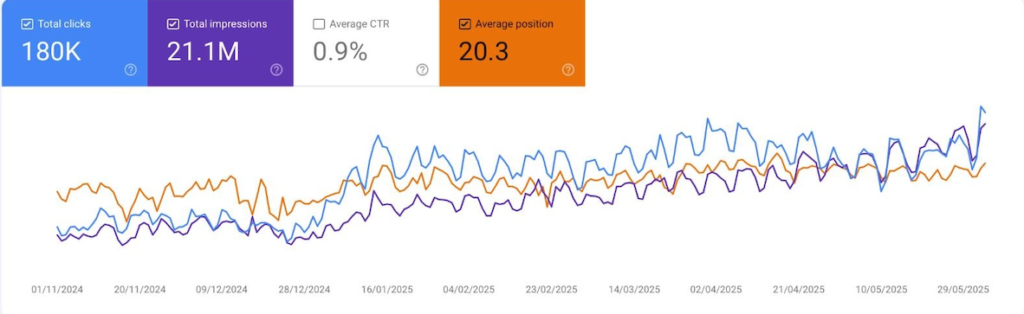
Google Search Console performance showing clicks, impressions, and average position from November 2024 to June 2025. All three metrics improve consistently from the engagement start date.
+155%
Daily traffic
11,203 → 27,481 daily organic sessions
+62%
Keyword coverage
29,924 → 46,800+ keywords ranking
2.8x
Top-3 growth
166 → 459 keywords ranking in pos 1–3
1.6x
Top-10 growth
1,409 → 2,269 keywords in pos 4–10
450+
Top-3 rankings
+196 keywords year on year in the top 3
180K
Total clicks over engagement period 21.1M impressions
Before and after — keyword position distribution
The most direct measure of ranking improvement is the shift in keyword position distribution from the engagement start to eight months later. The comparison below shows the full picture:
| Metric | Nov 2024 (start) | Jul 2025 (8 months) | Change |
|---|---|---|---|
| Total keywords ranking | 29,924 | 44,888 | +50% |
| Positions 1–3 | 166 | 459 | +177% |
| Positions 4–10 | 1,409 | 2,269 | +61% |
| Positions 11–20 | 2,733 | 4,747 | +74% |
| Positions 21–50 | 11,771 | 18,381 | +56% |
| Positions 51+ | 13,845 | 19,032 | +38% |
Growth was strongest at the most commercially valuable end of the ranking distribution — positions 1–3 nearly tripled, while mid-range positions (11–20) grew by 74%. This pattern is consistent with structural SEO improvements rather than content additions alone — technical and architectural fixes tend to lift existing pages across the ranking distribution, with the highest-quality pages benefiting most.
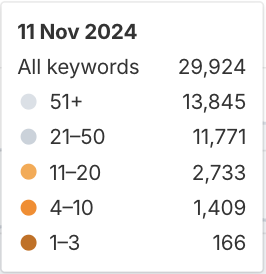
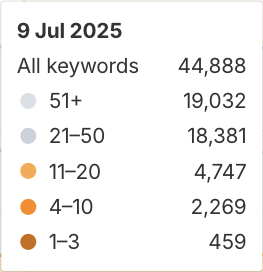
Left: Ahrefs keyword position breakdown at engagement start, 11 November 2024. Right: Same view on 9 July 2025, eight months later.
Traffic trajectory — specific data points
The Ahrefs traffic data provides a precise before/after baseline rather than a trend line:
- 5 November 2024 (engagement start): 11,203 daily organic sessions
- 19 July 2025 (peak): 27,481 daily organic sessions
- Net change: +145% in daily traffic over approximately 8.5 months
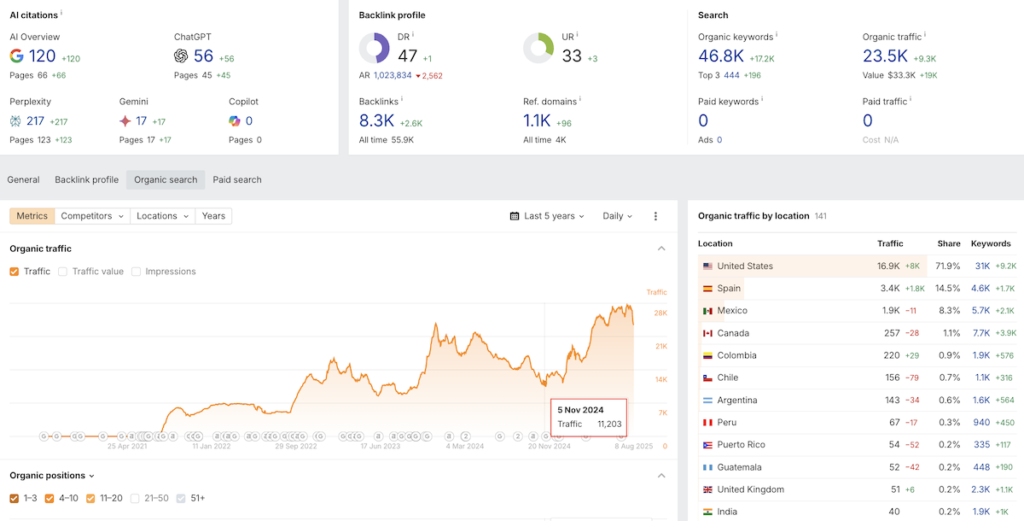
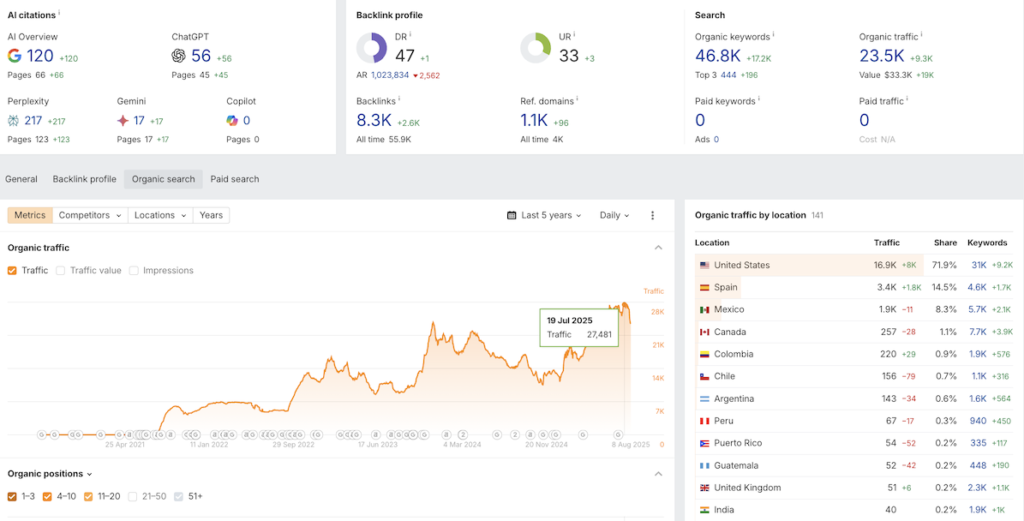
Left: Ahrefs site overview with hover showing 11,203 daily traffic on 5 November 2024. Right: Same view with hover showing 27,481 daily traffic on 19 July 2025.
Keyword visibility — transactional query rankings
Ranking gains were concentrated in the most commercially valuable part of the keyword map — transactional queries with buy and order modifiers in the US market. Multiple product terms for high-demand GLP-1 medications achieved top-3 positions, with strong upward momentum across both buy-intent and order-intent query clusters.
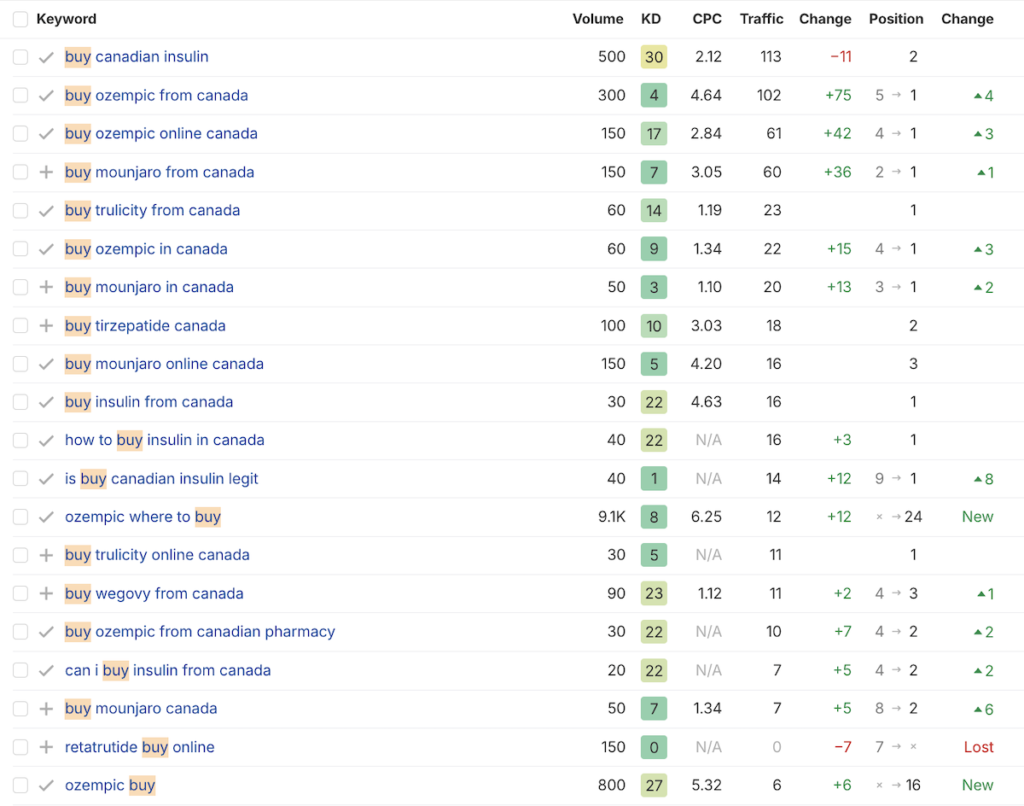
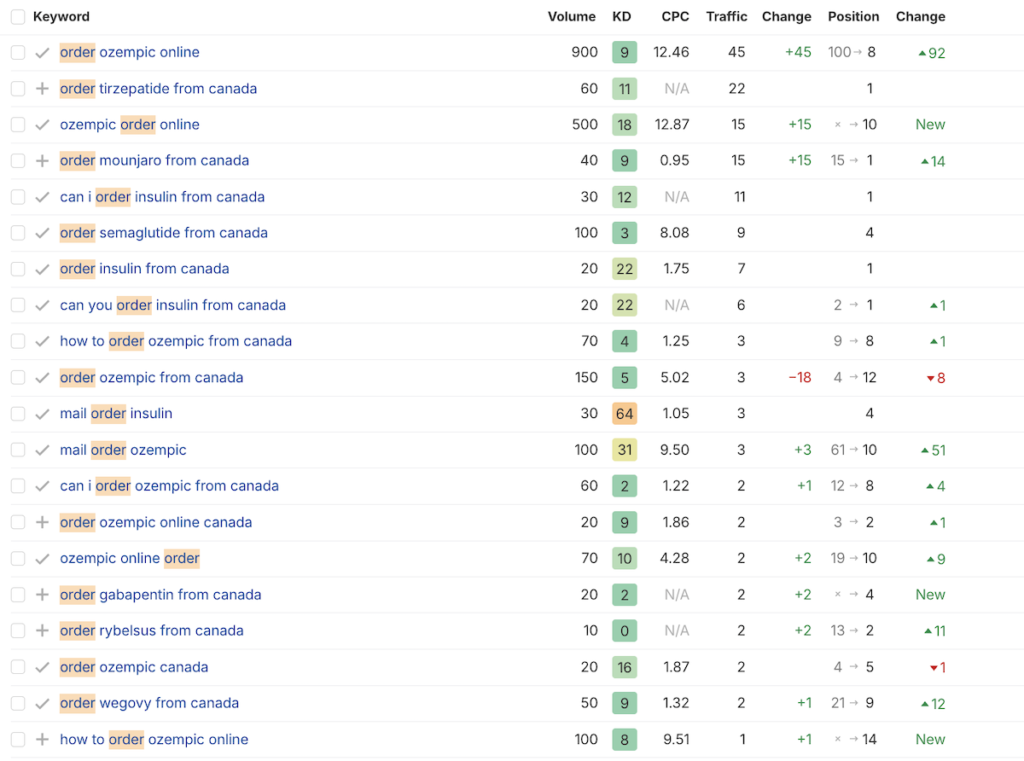
Ahrefs keyword ranking data showing transactional US keyword positions. Multiple terms holding top-3 positions across buy and order intent clusters, with notable momentum for GLP-1 medication queries.
AI search presence
An additional outcome of the content architecture and schema implementation was significant AI citation presence — 120 citations in Google AI Overviews across 66 pages, 56 in ChatGPT across 45 pages, and 217 in Perplexity across 123 pages. For a YMYL site in the pharmacy category, being surfaced as a trusted source by generative search engines represents a meaningful emerging visibility channel — and reflects the same underlying content quality signals that drive traditional organic rankings.
What made the difference
The results on this project came from addressing several compounding problems in the right sequence — structural issues first, then architecture, then on-page — so that each layer of improvement could build on the one before it. Fixing content without resolving the duplicate page problem would have produced modest gains at best. Fixing the keyword architecture without the technical foundation would have been similarly limited.
Online pharmacy is a sector where Google’s scrutiny is at its highest and where shortcuts are penalised most severely. The gains here came from doing the fundamentals correctly at every level: clean technical structure, a coherent keyword architecture with no internal competition, content genuinely matched to search intent, and trust signals appropriate to a YMYL environment. The AI citation presence that emerged as a secondary outcome reflects the same principle — well-structured, authoritative content tends to surface well in both traditional and generative search because the underlying quality signals are the same.
The speed of impact is also worth noting. Measurable ranking improvements within six to eight weeks of the technical fixes is faster than typical for a site of this scale and complexity. It reflects how much latent potential was being suppressed by the structural problems — once those were removed, the existing content could perform closer to its true capability.
Working in regulated and high-scrutiny industries
This engagement is representative of the type of work I do — technically complex, structurally challenging, in a sector where the margin for error is small and the requirement for genuine expertise is high. My background includes approximately ten years in iGaming SEO across operator and affiliate businesses, alongside projects in finance, healthcare, and pharmacy. These sectors share a common characteristic: standard approaches are rarely sufficient, and the difference between good and average SEO practice is most clearly visible in results.
Find out more about my technical SEO services, SEO strategy work, and background and sector experience. If you operate in a regulated or competitive industry and are dealing with SEO challenges that generalist approaches have not resolved, I am happy to discuss your situation directly.