
Programmatic SEO (pSEO) is one of the most misunderstood concepts in modern search.
At a surface level, it’s simple: use structured data, templates, and automation to create large numbers of pages targeting long-tail keywords.
In practice, most implementations fail.
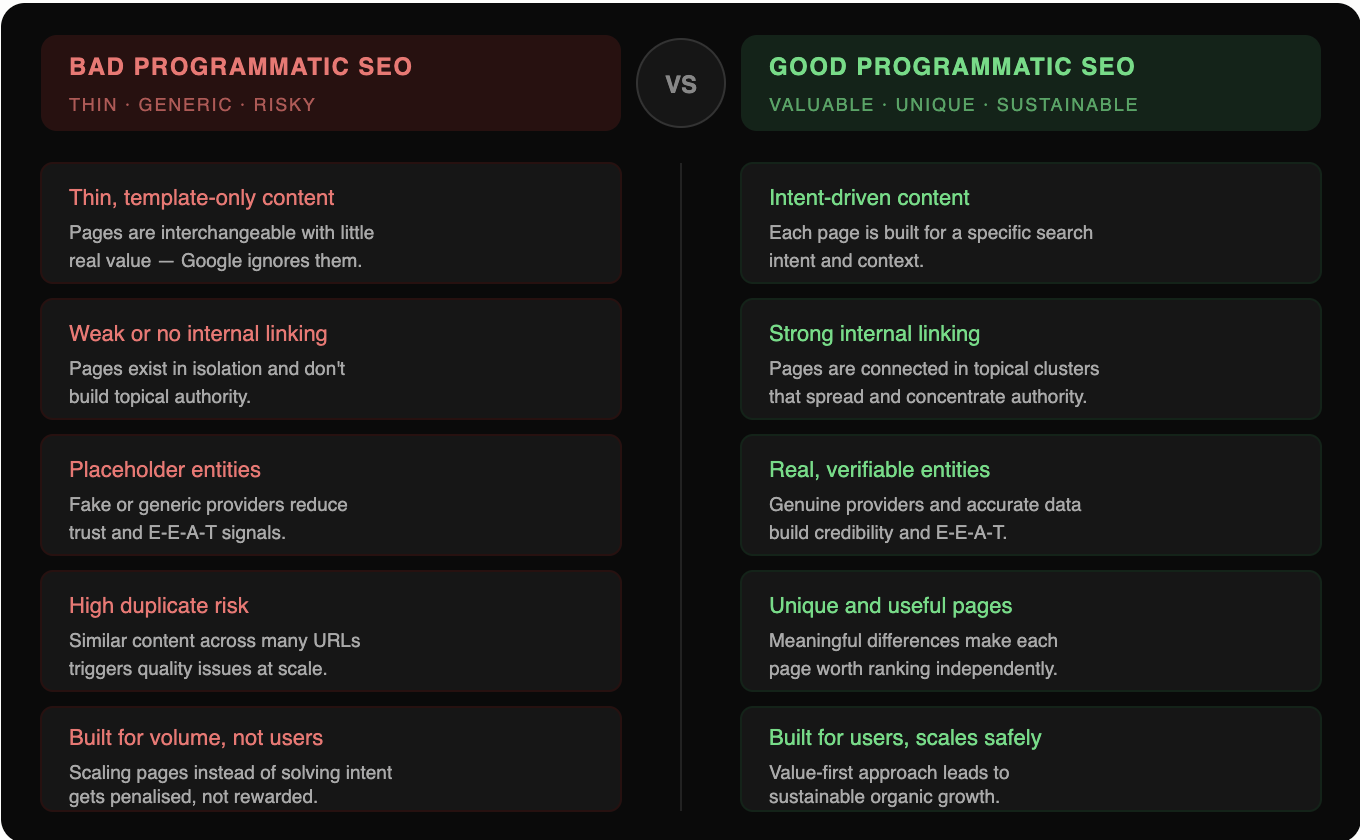
The difference isn’t technical – it’s strategic. Good programmatic SEO creates scalable, useful pages. Bad programmatic SEO creates thin, interchangeable content that never ranks (or doesn’t last).
This guide breaks down how programmatic SEO actually works, where it goes wrong, and how to build it properly – especially if you’re operating in a competitive or regulated niche.
What Is Programmatic SEO?
Programmatic SEO is the process of generating landing pages at scale using structured data and templates.
Instead of creating pages one by one, you build a system that produces pages automatically based on combinations of entities, attributes, and search intent.
Common examples include:
- Product + modifier (e.g. “best CRM for startups”)
- Location + service (e.g. “plumber in London”)
- Product + comparison (e.g. “X vs Y”)
- Medication + provider (e.g. online pharmacy comparisons)
This is often referred to as:
- automated SEO
- content automation
- template-based content
- dynamic page generation
- SEO at scale
But those terms miss an important point: programmatic SEO is not just automation – it’s structured content design.
How Programmatic SEO Works
Most programmatic SEO systems follow the same core process:
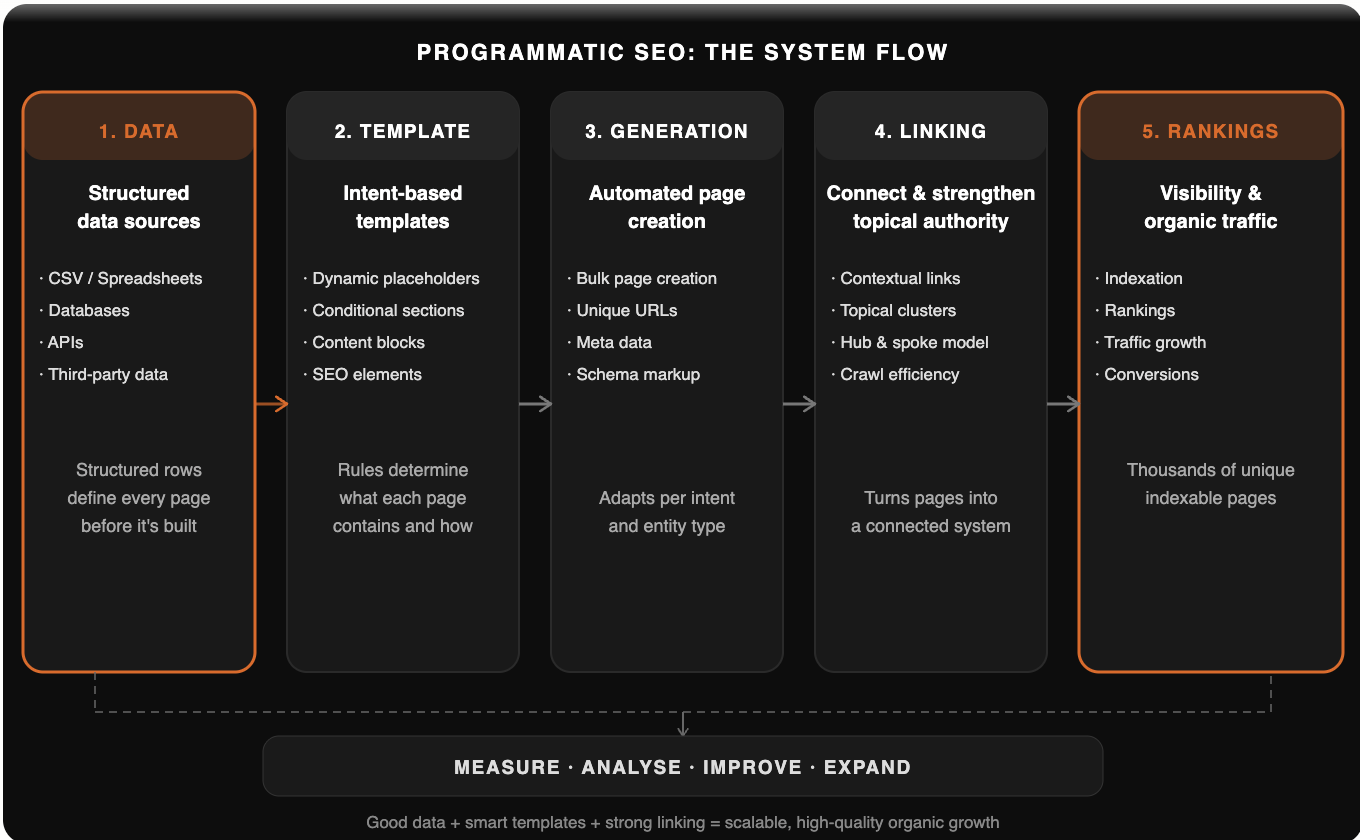
1. Data Sourcing and Structure
Everything starts with structured data.
This could be:
- CSV files
- databases
- APIs
The data typically includes:
- core entities (products, services, locations, providers)
- attributes (price, features, availability)
- relationships (alternatives, comparisons, categories)
Your data model defines your site architecture. If the structure is weak, the entire system breaks.
2. Template-Based Content
Templates convert structured data into indexable pages.
Basic templates use simple placeholders:
- titles and headings
- repeated paragraphs
More advanced implementations use:
- conditional sections (e.g. cost, comparison, availability)
- context-aware content blocks
- variation in structure and phrasing
This is where most programmatic SEO efforts fail – templates are treated as shortcuts instead of systems.
3. Automated Page Generation
Pages are created in bulk using:
- WordPress + import tools
- custom frameworks (e.g. Next.js)
- headless CMS setups
The goal is not just bulk page creation – it’s clean, crawlable, indexable pages at scale.
4. Internal Linking and Site Structure
Internal linking is critical in programmatic SEO.
Strong implementations:
- connect related entities
- reinforce topical clusters
- guide users through logical journeys
Weak implementations leave pages isolated, relying entirely on sitemaps.
Programmatic SEO Examples and Use Cases
Programmatic SEO is used across multiple industries:
SaaS
- integration pages (“X integrates with Y”)
- feature comparisons
E-commerce
- category + filter combinations
- product comparison pages
Local Services
- location-based landing pages
- service + city combinations
Marketplaces and Aggregators
- provider comparisons
- price aggregation
A structured example of this approach can be seen in systems like the online pharmacy guide on MediSearcher.com , where pages are built around real entities, attributes, and intent-specific sections rather than generic templates.
If you want to see how this works in a real, regulated niche, here’s a practical breakdown of how I built a programmatic SEO pharmacy comparison site, including the mistakes, trade-offs, and structural decisions behind it.
Benefits of Programmatic SEO
When implemented correctly, programmatic SEO offers clear advantages:
- Scalability: Create thousands of pages from a single system
- Speed: Faster than manual content production
- Long-tail coverage: Capture high-intent queries at scale
- Efficiency: Reduce cost per page over time
The real advantage is not volume – it’s structured coverage of entire keyword clusters.
Best Practices for Programmatic SEO
To make programmatic SEO work long-term, focus on quality and structure.
1. Build Around Real Entities
Use verifiable, consistent data. Avoid placeholders or vague entities.
2. Match Content to Search Intent
Different queries require different structures:
- comparison pages
- cost pages
- informational pages
3. Avoid Thin or Duplicate Content
If pages are interchangeable, they won’t perform.
4. Implement Quality Control
Use crawling tools and manual QA to ensure consistency and accuracy.
5. Maintain E-E-A-T Signals
This is critical in regulated niches like health and finance:
- accurate information
- clear entities
- trustworthy structure
Common Challenges in Programmatic SEO (And How to Fix Them)
Duplicate or Low-Value Content
Fix: introduce variation, intent-specific sections, and real data.
Indexing Issues
Fix: improve internal linking and crawlability.
Quality at Scale
Fix: treat templates as systems, not shortcuts.
Google Algorithm Sensitivity
Fix: prioritize usefulness over volume.
Programmatic SEO Tools and Stack
Common tools used in programmatic SEO include:
- data handling: spreadsheets, databases
- CMS: WordPress, headless CMS
- automation tools: import systems, scripts
- SEO tools: Ahrefs, SEMrush
- QA tools: crawling and auditing platforms
Tools don’t create programmatic SEO – they execute it.
Programmatic SEO vs Traditional SEO
Traditional SEO:
- manual content creation
- editorial focus
- slower scaling
Programmatic SEO:
- automated content creation
- structure-first approach
- high scalability
The strongest strategies combine both approaches.
Final Thoughts on Programmatic SEO
Programmatic SEO is not a shortcut – it’s a system.
If you treat it as bulk page generation, it will fail.
If you treat it as structured content engineering where data, intent, and credibility are built into the system – it becomes one of the most powerful ways to scale organic search.
The difference is not how many pages you create, but how useful each page is.